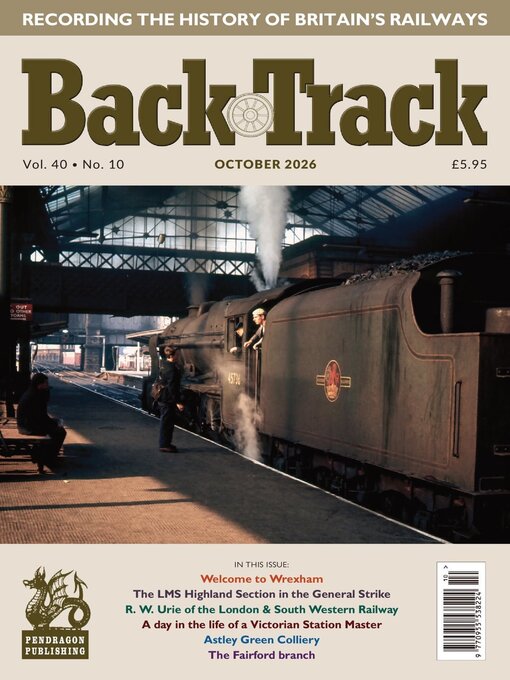
 Volume 40 No 10 - October 2026
 Volume 40 No 9 - September 2026
 Volume 40 No 8 - August 2026
 Volume 40 No 7 - July 2026
 Volume 40 No 6 - June 2026
 Volume 40 No 5 - May 2026
 Volume 40 No 4 - April 2026
 Volume 40 No 3 - March 2026
 Volume 40 No 2 - February 2026
 Volume 40 No 1 - January 2026
 Volume 39 No 12 - December 2025
 Volume 39 No 11 - November 2025
 Volume 39 No 10 - October 2025
 Volume 39 No 9 - September 2025
 Volume 39 No 8 - August 2025
 Volume 39 No 7 - July 2025
 Volume 39 No 6 - June 2025
 Volume 39 No 5 - May 2025
 Volume 39 No 4 - April 2025
 Volume 39 No 3 - March 2025
 Volume 39 No 2 - February 2025
 Volume 39 No 1 - January 2025
 Volume 38 No 12 - December 2024
 Volume 38 No 11 - November 2024
Backtrack, Britain's Leading Historical Railway Journal, covers all aspects of railway history from its earliest days through to more recent events up to around ten years before now including, early railway history from the 'pre-Stephenson' era, steam, diesel and electric locomotive history, railway company history, railway carriages and wagons, railway stations, railway ships, hotels & road vehicles, railway economic and social history, railway publicity and advertising. Backtrack's contributors include many of today's leading railway history writers. From the beginning the magazine has maintained a reputation for its production values and each issue contains a wealth of photographs reproduced to the highest standards, including a generous selection of historic colour. Published monthly, Backtrack is THE magazine for all who are interested in British railway history.
Editorial • Only connect
A KING IS ALWAYS A KING… • The March 1962 edition of The Railway Observer reported the condemnation of Great Western Railway ‘King’ 4-6-0 No.6006 King George I at Swindon Works on 15th February and it was probably thought the class would be gradually phased out as heavy repairs became due. The reality, however, was somewhat different; the entire class was quickly eliminated and all 30 locomotives had gone by the end of the year, though one was held in store for a farewell special the following April (see p608). These photographs of ‘Kings’ in their final months were taken by MARTIN SMITH.
THE NORTH BRITISH RAILWAY AND ROSYTH NAVAL BASE
A DAY IN THE LIFE OF A VICTORIAN STATION MASTER PART ONE EVOLUTION OF THE ROLE • That respected figure the station master was the most senior railway official members of the public would probably encounter. ANTHONY DAWSON looks at what their work entailed.
MR. WEBB’S COMPOUND EXPRESS LOCOMOTIVES
THE CONFERENCE OF MOTIVE POWER OFFICERS PART SIX
CLASS OF 92 • 46 of these these powerful dual-voltage Class 92 electric locomotives were built between 1993 and 1996 by ABB Transportation and Brush Traction. DAVID J. HAYES presents a pictorial reminder of when they were a familiar sight powering freights in and out of Bescot Yard.
WATCHING THE WATCHERS • No doubt many of us started like this: watching the trains go by, then collecting engine numbers, getting to know more about them, taking photographs of them… and then becoming part of the photographs! These scenes from the SIMON LATHLANE Collection reveal how.
THE LMS HIGHLAND SECTION IN THE 1926 GENERAL STRIKE • One hundred years have passed since the calling of the General Strike, a landmark event in the history of industrial relations, in which railway workers were heavily involved. JOHN ROAKE looks at the effects on the strike in northern Scotland. Photographs from the Highland Railway Society Collection.
AS IT WAS ON THE FAIRFORD BRANCH • A branch from Yarnton, on the Oxford, Worcester & Wolverhampton Railway, ran for 25½ miles through Oxfordshire and Gloucestershire to Witney and Fairford. The first section to Witney was opened in 1861 and was extended to Fairford in 1873, later being taken over by the Great Western Railway in 1890. The branch was a pre-Beeching closure in June 1962, though freight continued from Witney to Yarnton Junction until 1970. TOMMY TOMALIN visited the branch in 1962.
CROESO E WRECSAM WELCOME TO WREXHAM
R. W. URIE AS SEEN THROUGH THE EYES OF C. S. LAKE, ERIC LANGRIDGE AND OTHERS
ASTLEY GREEN THE LAST GREAT STEAM SHOW PART ONE
READERS’FORUM • Letters intended for publication should ideally add extra detail to our articles (or offer corrections of course!) and not be too long, consistent with the detail they offer. As always, we are sorry that space and time prevent us from printing them all or sending personal replies....