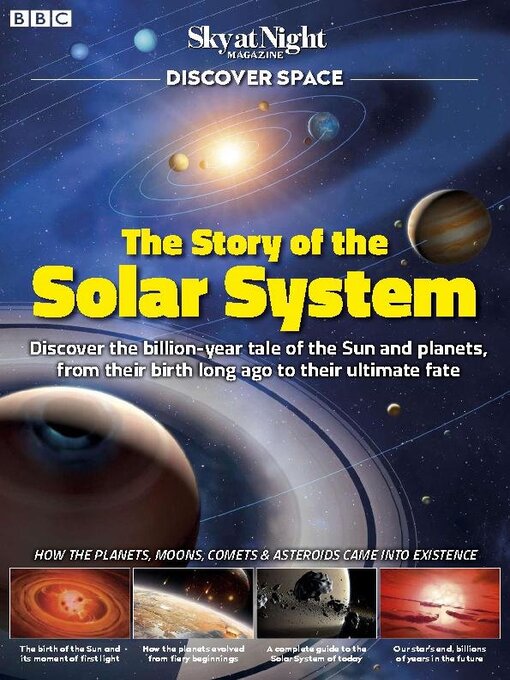
The bodies of the Solar System have orbited continuously around the Sun since they formed, but have you ever wondered they got there? In The Story of the Solar System, we bring you the story of how the Sun was born from a vast cloud of gas and dust, how the planets formed around our central star and how the Solar System has evolved over the past five billion years. Packed with vivid illustrations and the latest photography, The Story of the Solar System uncovers how the planets, moons, asteroids and comets of the Sun came to be, and where their ultimate fate lies.
Welcome
Introduction • By observing the unique characteristics of our Solar System, we can discover so much about our planetary system's past, present and future
Part 1: Genesis of the Sun and solar nebula • 'Let there be light' The Bible Genesis 1:3
Time zero: Giant molecular cloud • All the raw ingredients of our Solar System were contained in a vast, interstellar fog
2 million years: Solar globule • A small fragment of molecular cloud began to warm up over millions of years, becoming an incubator for the Sun
2.03 million years: Protosun • As its core continued to heat up, the solar globule transformed gradually into a protostar which started to spin
2.13 million years: Solar nebula • A fattened disc of swirling gas around a protostar created a vast reservoir of raw material in which planets could evolve
3 million years: T-Tauri phase • The Sun's rotation clashed with its magnetic field, resulting in bursts of violent activity
3 million years: Outflow and post-T-Tauri phase • The Sun's mass began to stabilise after a powerful wind dispersed charged particles deep into space
30-50 million years: Main sequence • The Sun as we know it was born. As it reached its peak temperature it began burning hydrogen in its core
PART 2: Emergence of the Sun's family • 'Space may produce new worlds'
2.2 million years: Planetesimals and protoplanets • Condensation in the solar nebula caused rocks to form, an early stage of planet production
2-3 million years: Gas giants and asteroids • Jupiter, after forming from a giant ball of ice, rock and gas, underwent a cosmic migration
3-10 million years: Ice giants and comets • Uranus and Neptune evolved in the solar nebula's outer reaches and pushed comets near to the Sun
3-10 million years: Regular satellites • As the giant planets took shape, their moons began orbiting, maturing in size more quickly
10-100 million years: Terrestrial planets • Close to the Sun, the four terrestrial planets took the longest time to gather debris and grow in size
0.1-1.3 billion years: bombardment The heavy • Over hundreds of millions of years, deep craters formed on the planets as debris rained down
0.7-1.3 billion years: Cooling down • The bombardment of the terrestrial planets allowed gases to form secondary atmospheres
4.5 billion years: Formation of ring systems • It is likely that Saturn's rings were formed out of the broken remains of comets and moons
4.66 billion years: The modern Solar System • Billions of years of activity have left countless clues about the creation of today's Solar System
PART 3: The Solar System past and present • ‘Everything flows and nothing stays’ Heraclitus Cratylus (Plato)
The Sun Our local star • The structure of the Sun, the star at the heart of our Solar System, has changed very little since it formed
Mercury Planet of iron • The nearest planet to the Sun has a scorched surface of rocky craters and a vast iron core
Venus Planet from hell • With clouds of sulphuric acid, high pressure and soaring heat, Venus is far from welcoming
Earth The blue planet • Our life-rich Earth...